


When you hear market reporters say, “The market is up today,” they are often referring to the performance of the Dow Jones Industrial Average (DJIA). As the second-oldest stock market index in the United States, the Dow serves as a quick snapshot of the U.S. economy’s health. It tracks 30 of America’s most prominent and established companies, making its daily movements a focal point for investors, economists, and even the general public.
But what exactly is the DJIA? It’s a stock market index created in 1896 by Charles Dow and his business partner, Edward Jones, to serve as a proxy for the broader U.S. economy. Understanding this index, often called the “Dow 30,” is crucial for anyone interested in finance, from seasoned investors managing complex portfolios to beginners just starting their financial journey. For more insights on how to scale a business successfully, understanding market indicators like the Dow is a foundational step. Similarly, having a grasp of basic financial concepts is essential for anyone exploring small business ideas.
This guide offers a comprehensive look at the Dow Jones Industrial Average, exploring its rich history, how it’s calculated, what companies it includes, and its role in the modern financial world.
Table of Contents
The History of the Dow Jones Industrial Average
The story of the DJIA begins with two visionary journalists, Charles Dow and Edward Jones. In the late 19th century, they recognized the need for a simple, reliable way to gauge the health of the American industrial sector. On May 26, 1896, they launched the Dow Jones Industrial Average, initially comprising just 12 industrial giants. These were companies at the heart of the American economy, involved in sectors like railroads, gas, sugar, tobacco, and oil.
The original 12 companies included now-historic names such as American Cotton Oil, General Electric (the only original member to remain in the index for over a century), and U.S. Leather. The index’s initial value was a simple average of the stock prices of these 12 companies, starting at 40.94.

Over the decades, the DJIA evolved to reflect the changing American economy.
- In 1916, the number of component stocks increased from 12 to 20.
- By 1928, it expanded to 30 stocks, which remains the standard today.
The Dow has witnessed and recorded the U.S. economy’s most significant moments, from the Roaring Twenties and the Great Depression to the dot-com bubble and the 2008 financial crisis. Its ability to adapt by changing its component companies ensures it remains a relevant, though sometimes criticized, barometer of the nation’s economic pulse. This adaptability is a key principle in business, whether you’re managing a financial index or learning how to scale a business successfully.
How Is the Dow Jones Industrial Average Calculated?
Unlike many other major indices, the DJIA is a price-weighted index, not a market-capitalization-weighted one. This is one of its most defining and controversial features.
Initially, Charles Dow calculated the index’s value by adding up the stock prices of its 12 components and dividing by 12—a simple arithmetic mean. However, this method became problematic as companies underwent stock splits, spinoffs, or were replaced in the index. These events would artificially change the index’s value without any real change in the market.
The Role of the Dow Divisor
To solve this problem, the Dow Divisor was introduced. The divisor is a numerical value that is adjusted to maintain the continuity of the index’s value despite structural changes like stock splits or component swaps. The formula is:
DJIA Value = Σ (Component Stock Prices) / Dow Divisor
The Dow Divisor is managed by S&P Dow Jones Indices, the entity that oversees the DJIA today. As of late 2024, the divisor is approximately 0.152. This means that a one-dollar change in the price of any of the 30 stocks will move the Dow by about 6.56 points (1 / 0.152).
This price-weighting methodology means that stocks with higher share prices have a greater influence on the index’s movement, regardless of the company’s overall size or market capitalization. For instance, a stock trading at $500 has five times the impact on the Dow as a stock trading at $100. This is a significant point of contrast with market-cap-weighted indices like the S&P 500. For those interested in a deeper understanding of financial management, exploring resources on ERP for small business can provide valuable context on how companies manage their finances.
The Companies of the Dow 30
The 30 stocks in the DJIA are often referred to as blue-chip companies. These are large, well-established, and financially sound companies that are leaders in their industries. The components are not selected based on a rigid formula but are chosen by a committee at S&P Dow Jones Indices. The committee aims to select companies with an excellent reputation, a history of sustained growth, and broad investor interest.
The companies in the Dow trade on the New York Stock Exchange (NYSE) and the Nasdaq. While the index was originally focused on industrial companies, today it includes giants from a wide range of sectors, including technology, healthcare, finance, and consumer goods.
Here are some of the well-known companies currently in the DJIA:
- Technology: Apple (AAPL), Microsoft (MSFT), Salesforce (CRM)
- Finance: Goldman Sachs (GS), JPMorgan Chase (JPM), Visa (V)
- Healthcare: Johnson & Johnson (JNJ), Amgen (AMGN), UnitedHealth Group (UNH)
- Consumer: Coca-Cola (KO), McDonald’s (MCD), Walmart (WMT), Home Depot (HD)
- Industrial: Boeing (BA), Caterpillar (CAT), Honeywell (HON)
Reflecting Economic Shifts: Component Changes
The composition of the DJIA is not static. Companies are added or removed to ensure the index continues to reflect the state of the U.S. economy. These changes often mark major shifts in economic trends.
For example:
- In 1999, at the height of the tech boom, Microsoft and Intel were added, signaling the growing importance of the technology sector.
- In 2020, ExxonMobil, a long-standing component, was replaced by Salesforce, highlighting the shift from an industrial- and energy-based economy toward a technology- and service-driven one.
- In 2024, NVIDIA Corporation (NVDA) was added, replacing Intel. This move underscored the massive influence of artificial intelligence and advanced semiconductors on the modern economy.
These adjustments, though infrequent, are critical for maintaining the Dow’s relevance as a barometer of the U.S. market. The strategic thinking behind these changes mirrors the decisions entrepreneurs make when considering digital transformation strategies for their own ventures.
DJIA vs. S&P 500: What’s the Difference?
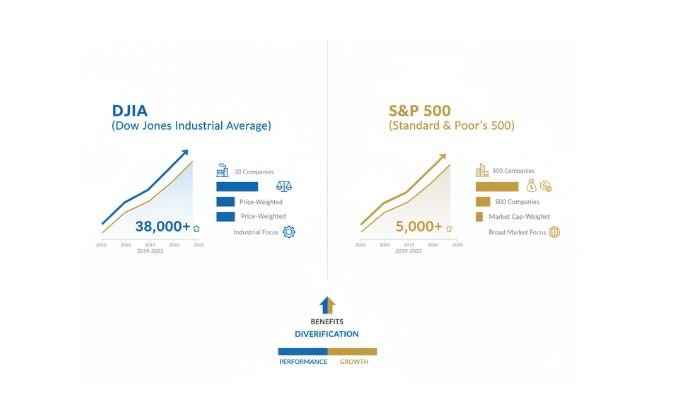
While the Dow is perhaps the most famous stock market index, many financial professionals argue that the S&P 500 is a better representative of the U.S. stock market. Here’s a comparison to help you understand their key differences:
| Feature | Dow Jones Industrial Average (DJIA) | S&P 500 |
|---|---|---|
| Number of Companies | 30 large-cap, blue-chip companies. | 500 of the largest U.S. companies. |
| Weighting Method | Price-weighted. Higher-priced stocks have more influence. | Market-cap-weighted. Larger companies have more influence. |
| Selection Process | Selected by a committee. | Based on specific criteria (market size, liquidity, profitability). |
| Sector Representation | Represents major sectors but is not comprehensive. | Broadly covers all 11 GICS sectors of the U.S. economy. |
| Primary Use | A quick, historical barometer of market sentiment. | A benchmark for professional fund managers and ETFs. |
The S&P 500, with its broader base of 500 companies and market-cap weighting, provides a more accurate picture of the overall economy’s health. However, the Dow’s long history and simplicity have cemented its place in the public consciousness. Many investors track both to get a complete view. If you wish to learn more about a diverse range of business topics, exploring platforms like LinkLuminous can be beneficial.
Investing in the Dow Jones Industrial Average
You cannot invest directly in the DJIA itself, as it is just a mathematical value. However, you can gain exposure to its performance by investing in financial products that track the index. This is a common strategy for investors who want to diversify their portfolios across 30 of America’s leading companies without buying each stock individually. These investment principles are also relevant for those considering starting an Amazon business.
My Experience: Investing Through a Dow ETF
When I first started investing, the idea of picking individual stocks was daunting. I wanted a simple way to invest in the broader market. I was drawn to the Dow because of its iconic status and the quality of its component companies. My first major investment was in the SPDR Dow Jones Industrial Average ETF (DIA).
This ETF, often called “Diamonds,” aims to replicate the performance of the DJIA. By buying a single share of DIA, I effectively owned a small piece of all 30 Dow companies.
What I Like About Investing in a Dow ETF:
- Simplicity: It’s a one-stop shop for investing in 30 blue-chip stocks.
- Diversification: It provides instant diversification across multiple sectors.
- Low Cost: The expense ratio for DIA is relatively low compared to actively managed funds.
- Dividends: The ETF collects dividends from the component stocks and distributes them to shareholders.
Areas for Improvement:
- Concentration: With only 30 stocks, it’s less diversified than an S&P 500 fund. A downturn in a high-priced stock like UnitedHealth Group can have a significant negative impact.
- Price-Weighting Flaw: The inherent price-weighting bias means your investment is not truly allocated based on company size.
Despite its limitations, investing in a Dow-tracking fund remains a popular and straightforward strategy, especially for beginners. The principles of market research applied here are also crucial when considering low-cost marketing ideas for startups.
Limitations and Criticisms of the DJIA
Despite its fame, the DJIA faces several valid criticisms from financial experts. Understanding these limitations is essential for any investor who uses the Dow to make decisions.
- Too Narrow: With only 30 companies, critics argue the DJIA is too small to represent the entire U.S. economy, which contains thousands of publicly traded companies. It omits major sectors like transportation and utilities (which have their own Dow Jones indices) and underrepresents small and mid-cap companies.
- Price-Weighted Flaw: This is the most significant criticism. A company’s stock price is not a reliable indicator of its size or importance. A stock split can reduce a company’s influence on the index, even though the company’s value remains unchanged. This is why a market-cap-weighted index like the S&P 500 is generally preferred by professionals.
- Lack of a Clear Selection Rule: The committee-based selection process is subjective and can lead to a lag in adding important, fast-growing companies or removing declining ones.
- Misleading as an “Industrial” Average: The name “Industrial Average” is a relic of the past. Today, the index is dominated by technology, healthcare, and financial companies, with very few traditional industrial manufacturers remaining.
While these criticisms are valid, the DJIA continues to be a powerful indicator of market psychology. Its movements often correlate closely with those of broader indices like the S&P 500, and its long history provides a unique lens through which to view the evolution of the American economy. Successful goal setting for success in business requires understanding these market dynamics.

Unlock Your Financial Knowledge
The Dow Jones Industrial Average is more than just a number on a screen; it’s a living piece of financial history that continues to shape how we understand the market. While it has its limitations, its role as a quick pulse-check of the U.S. economy is undeniable. By understanding what the DJIA is, how it works, and its place in the broader financial landscape, you are better equipped to make informed investment decisions and comprehend the forces driving the market. Whether you’re tracking the DJIA live ticker for daily trends or analyzing a long-term DJIA chart, this knowledge forms a crucial part of financial literacy.
For those eager to expand their business and financial knowledge further, exploring detailed guides on various topics can be immensely helpful. If you want to know more about business strategies and growth, you may visit sites like mumbaitimes.net for insightful articles.
Frequently Asked Questions (FAQ)
What does the Dow Jones Industrial Average measure?
The DJIA measures the stock performance of 30 large, publicly owned companies based in the United States. It is used as a barometer to gauge the overall health and sentiment of the U.S. stock market and, by extension, the economy.
When did the DJIA first top 10,000?
The Dow first closed above 10,000 on March 29, 1999, during the height of the dot-com boom. This milestone was seen as a major psychological barrier for the market.
How does the Dow differ from the Nasdaq Composite?
The Dow is a price-weighted index of 30 blue-chip companies from various sectors. The Nasdaq Composite is a market-cap-weighted index that includes over 3,000 stocks, with a heavy concentration in the technology sector.
Why is it called the “Industrial” Average?
The name is historical. When it was created in 1896, the index was composed almost entirely of major industrial companies. While the composition has changed dramatically, the original name has remained.
Can I predict the economy based on the DJIA today live movements?
While the Dow is a useful indicator, it’s not a crystal ball. Its daily movements reflect investor sentiment and can be volatile. It’s best used in conjunction with other economic indicators, such as GDP growth, unemployment rates, and broader indices like the S&P 500.
Author Bio
This article was written by a financial analyst and writer with over a decade of experience in market analysis and investment strategy. With a deep passion for making complex financial topics accessible to everyone, the author holds a Chartered Financial Analyst (CFA) designation and has contributed to numerous financial publications. The insights provided are based on hands-on experience in portfolio management and a thorough understanding of stock market dynamics.
References
- S&P Dow Jones Indices. (n.d.). Dow Jones Industrial Average.
- Investopedia. (2024). Dow Jones Industrial Average (DJIA).
- The Wall Street Journal. (Various dates). Market data and historical articles.
