

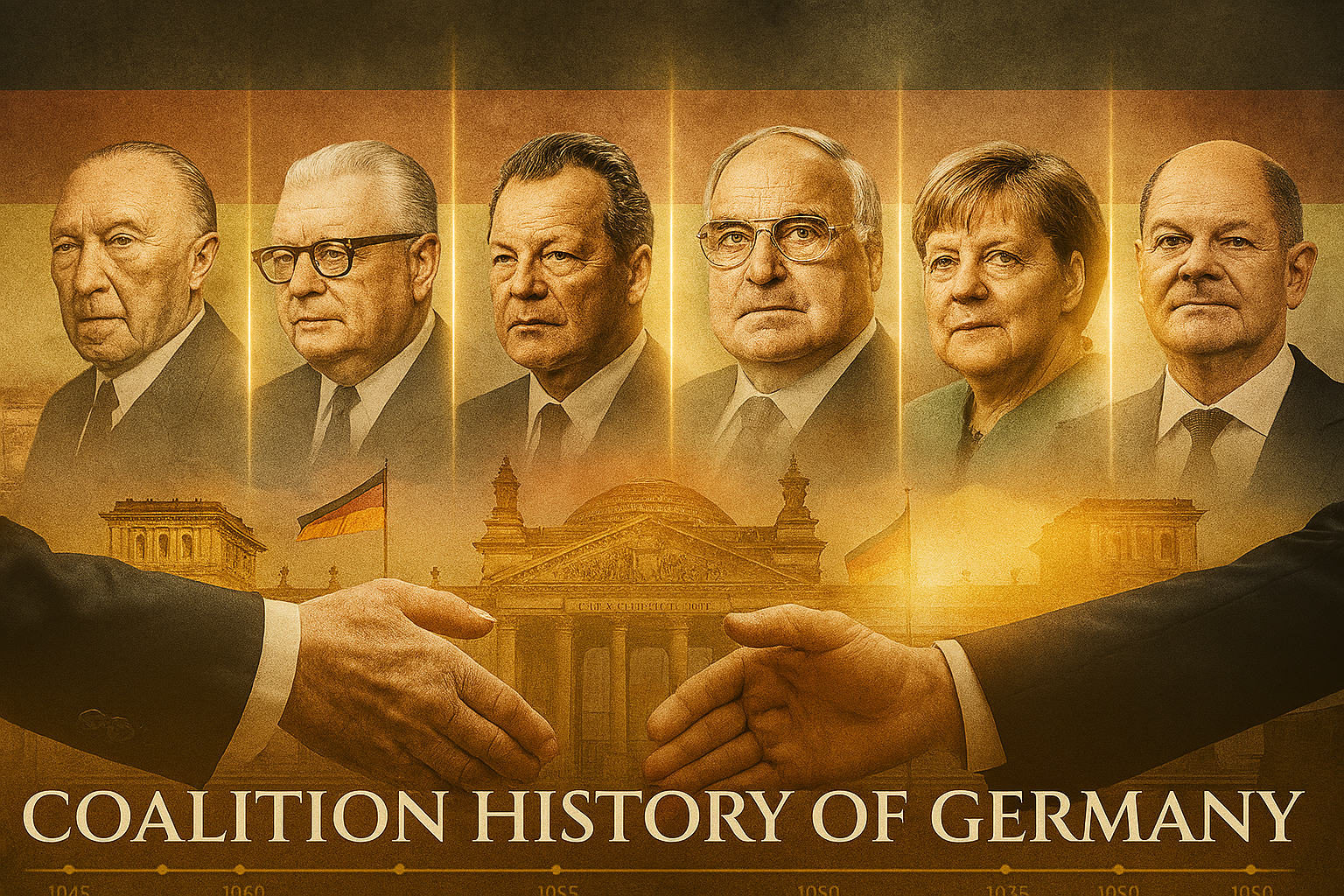
Germany often has coalition governments. This is because of its voting rules. Parties must join to get a majority in the Bundestag. The Bundestag is the federal parliament. Studying these coalitions shows how Germany’s democracy works.
What Is a German Coalition Government?
A coalition government in Germany happens when no single party wins a majority in the Bundestag. Parties join together. They form coalitions to get a majority and run the government. Coalitions also choose the Chancellor, the head of Germany’s government.
Germany’s Voting System
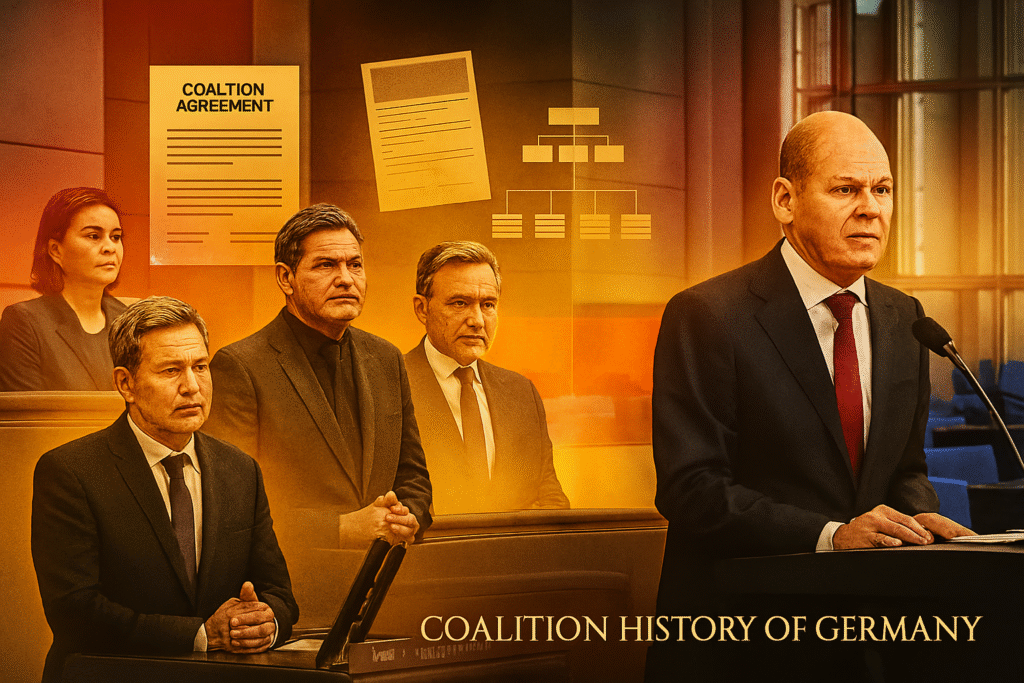
Germany uses a proportional representation system. Each voter has two votes. One vote is for a local candidate. The other vote is for a political party. This system makes the Bundestag reflect the votes each party gets. Many parties exist, so coalition governments are common.
Key Parties in Coalition Politics
- CDU/CSU: Center-right alliance, often dominant.
- SPD: Center-left party, strong in the Bundestag.
- FDP: Liberal party, supports free markets and personal freedoms.
- The Greens: Focus on the environment, social justice, and human rights.
- AfD: Right-wing populist party, usually excluded from coalitions.
Coalition Color Codes
Coalitions are often called by colors that match the parties:
- Traffic Light Coalition: SPD (red), FDP (yellow), Greens (green). In power 2021–2024.
- Jamaica Coalition: CDU/CSU (black), FDP (yellow), Greens (green). Discussed but not formed.
- Grand Coalition: CDU/CSU and SPD. Formed several times, including 2005–2009 and 2013–2017.
Coalition Agreements
Coalitions make agreements to guide the government. They show shared goals and key positions. For example, the 2025 CDU/CSU-SPD agreement focuses on economic growth, defense, and modernization.
The Role of the Bundestag
The Bundestag elects the Chancellor. It approves coalition agreements and watches the government. Its members show the political balance and results of coalition talks.
History of German Coalitions
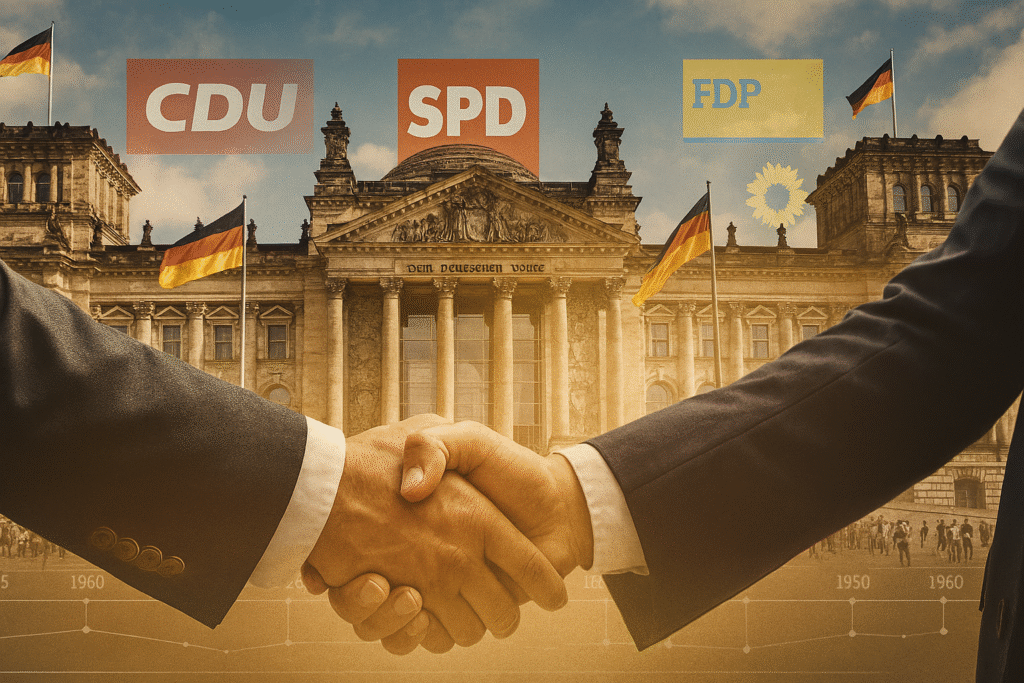
- Post-War Era (1949–1960s): The first Grand Coalition between CDU/CSU and SPD started in 1966.
- Schröder Era (1998–2005): SPD and Greens formed a “red-green” coalition. They focused on social and environmental reforms.
- Merkel’s Grand Coalitions (2005–2021): CDU/CSU-SPD coalitions focused on stability and economic growth.
- Traffic Light Coalition (2021–2024): SPD, FDP, and Greens aimed for progressive reforms but fell apart over budget issues.
- Merz-Scholz Coalition (2025–Present): CDU/CSU and SPD formed a coalition under Chancellor Friedrich Merz. They focus on economic reform, defense, and modernization.
Coalition Comparison Table
| Coalition Type | Parties Involved | Duration | Key Focus Areas |
|---|---|---|---|
| Grand Coalition | CDU/CSU & SPD | 1966–1969 | Consensus politics, economic stability |
| Red-Green Coalition | SPD & The Greens | 1998–2005 | Social reforms, environmental policies |
| Traffic Light Coalition | SPD, FDP & The Greens | 2021–2024 | Progressive reforms, social justice |
| Merz-Scholz Coalition | CDU/CSU & SPD | 2025–Present | Economic growth, defense, modernization |
Frequently Asked Questions
1. What is a coalition government?
A coalition government is formed when no single political party achieves an absolute majority in the Bundestag, leading multiple parties to collaborate to form a majority.
2. How is the Chancellor elected in Germany?
The Chancellor is elected by a majority vote in the Bundestag after coalition negotiations have been concluded.
3. What is the significance of coalition agreements?
Coalition agreements outline the shared policy goals and the distribution of key government positions among coalition partners, serving as the government’s guiding framework.
4. Why are coalitions necessary in Germany?
Due to the proportional representation electoral system, coalitions are necessary to ensure that the government reflects the diverse political landscape of the electorate.
5. How do coalition governments impact German politics?
Coalition governments promote consensus politics, encourage compromise, and ensure that a broader spectrum of political views is represented in governance.
Conclusion
Germany’s history of coalition governments reflects its commitment to democratic principles and political pluralism. These coalitions have evolved to address changing political landscapes and societal needs. Understanding this evolution provides valuable insights into the functioning of parliamentary democracies.
Discover trendy gadgets, smart accessories, and everyday tech essentials — all in one place.
Enjoy quality, style, and convenience delivered from Japan to your door.
Shop now at TokyoMart.store
Author Bio
Dr. Alexander Müller is a political scientist specializing in European political systems and coalition governance. He has authored several publications on German politics and is a regular contributor to international political analysis platforms.
References
- Bundestag – Germany’s federal parliament; central to coalition formation and chancellor election. Deutscher Bundestag
- Traffic Light Coalition – A coalition of SPD (red), FDP (yellow), and Greens (green); symbolic and frequently referenced. Wikipedia
- Jamaica Coalition – Coalition of CDU/CSU (black), Greens (green), and FDP (yellow); highlights coalition naming conventions. Wikipedia
- Alternative for Germany (AfD) – Far-right party; excluded from coalition-building due to ideology, relevant for opposition context. Wikipedia
- Proportional Representation – Electoral system that encourages coalition-building; explains mechanics of government formation. Deutscher Bundestag
- Coalition Agreement – The negotiated platform and division of cabinet positions among coalition partners. bundesregierung.de
- Opposition Parties – Political parties not in government; important for understanding parliamentary dynamics. Deutscher Bundestag
